July is coming and you can't get enough of swimming? No problem!!! Come and let's prepare for August! Let's swim together, cool off, play and have fun.



July is coming and you can't get enough of swimming? No problem!!! Come and let's prepare for August! Let's swim together, cool off, play and have fun.

July is coming and you can't get enough of swimming? No problem!!! Come and let's prepare for August! Let's swim together, cool off, play and have fun.
It's no secret that aerobic exercise can help stave off some of the ravages of aging. A growing body of research shows that swimming can provide a unique boost to brain health.
I want you to imagine with me a child who comes into the world as a small seed.. This seed has within it all the information to become what it is to become over time. It is different from all other seeds, even from its own kind. Other seeds are large and hard, but small, almost hairy, others light-colored, dark-colored, with millions of shapes, flavors, contents, colors….
Summer has arrived and it's time for our little fish to spill out onto the beaches...
From the very first day at the beach, most babies have a great time. However, don't be discouraged if your child is scared or shows no interest at all.
There are many reasons why a child might be "scared" when they see the vast sea and the sand they are not used to for the first time.
Below we will give you a few instructions for the sea for safe and happy swimming.
First, it's good to put ourselves in our child's shoes. If you were stepping on sand for the first time, how would you feel? A little ticklish, a little strange? Well, that's how children feel too! Show them how to play with sand and talk about hygiene rules (e.g. we don't eat it, or we put a towel on to sit on the sand). Also, for babies, the sea looks like a vast living landscape of water that moves non-stop... and it's a little cold here, by the way! So, if you give them some time to adjust to the new conditions, they're sure to love it.
Children are very strong receivers of our energy. If we are relaxed, the child will be able to overcome any fears he may have. Only in this way will we have a good time with him, but we will also bond more. The best thing you can do in the first baths is to show him the properties of water with your hands (e.g. lifting water with your fingers to make a waterfall, or look! this is how waves are made by pushing the water hard, or look how I float! Look how I dive, etc.)
Children, no matter what age, only learn through play, so it's a good idea to use all our imagination to make a trip to the beach enjoyable.
For infants, 10 minutes is enough for a first contact with the sea. As they grow older, children themselves show us how much time they want to spend in the water. However, no matter how much they want to, excessive exposure to the sun – with or without a hat – or too many dives should be avoided.
When the time comes and your child feels ready to enter the sea, don't use armbands but spaghetti! Armbands are anti-swimming as they don't encourage arm movement. The child rests and doesn't learn to clap their hands. After all, spaghetti has a thousand and two uses for water games.
It is recommended that children not eat at least 2-3 hours before, but not during, swimming, because if we eat, blood concentrates in the stomach for the digestion process, and if we enter the water, we force the heart to work harder, to get blood to the stomach and muscles for swimming.
Liquids, on the other hand, are highly recommended!
Sunscreen with an SPF of up to 30 – which does not have additional chemicals – is most recommended by experts.
It is best not to use sunglasses until the age of seven, because the eye gets used to them and becomes "lazy".
The macaroni, the board and other lifebuoys do not replace supervision.
Therefore, be careful throughout your child's stay in the water, no matter how familiar they are with swimming! Usually, children who know how to swim have learned to respect the water and know their limits. So if your child doesn't want to go in the deep end, even though he swims, be happy, because he has learned to believe in himself at a healthy level and has learned to enjoy the water with respect for it.
And don't forget! The boldest are also the most feared, Be careful of mattresses and balls that are blown away by the wind at sea and can carry the child away from a safe place.
Do not allow your child to swim when there are waves or sea currents, which are not only dangerous for children, but also for us adults.
The child should swim in the shallows. Remember! An arm's length is the only safe distance between you and the child, so you can pull it out of the water if needed.
Do not allow your child to dive unless you have made sure that the depth in that part of the sea is safe and there are no rocks or stones protruding.
It is best to go to the sea in the morning hours of 8:00-11:00 and in the afternoon from 18:00 onwards when the sea is warmer but also calmer.
If the child's lips turn blue/purple and he or she shows signs of fatigue, remove the child from the water immediately and wrap him or her in a dry towel.
Make circular movements, let the water run down the child's body, Put it in a supine position - walk it around.
Do not splash water on your face and especially your eyes because the salt water can sting and scare them.
Find your own toys that will excite them!
If you have the courage to carry – in addition to the essentials – your entire dowry to the beach, then don't forget the buckets to create your own sand dynasty! The boards also have many uses, such as a sand chair and a boat for the sea. The pools and the balls that fly here and there, just come to take the game off! Also, for the familiar children, remember to take goggles that will give the children an extra incentive to dive to see the bottom. Not to mention that their eyes won't sting and the child will be more comfortable.
Have a wonderful summer, full of new experiences and memories!
Read more tips for new moms

10:00 PM and still going strong... you with one eye closed and the kid going crazy!
Will he ever sleep? you think...
First, we should clarify that it is completely normal for an infant to wake up during the night. A breastfed child may wake up constantly because it is necessary for their development! Sleep for infants is divided into two cycles: REM sleep (restless sleep) which builds the child's mind and NonREM sleep (deep) which builds their body. Nature has foreseen and invested in the first years of human life, in a long duration of restless sleep, in order to meet their enormous needs for psychomotor maturation. Later, when childhood leads to greater mobility and physical exertion during the day, deep sleep gradually increases, so that the body rests more and physical development accelerates.
So what's the problem? He better wake up!
Um, but come on, fatigue comes and breaks you down... Here are some tips so you don't completely lose your mind trying to fix this one of his...!!!
Try co-sleeping or co-bedding
Co-sleeping is the sleeping of the baby in the parents' bed. Sleeping with the mother helps to continue exclusive breastfeeding and helps babies maintain adequate thermoregulation, achieving a smooth body temperature throughout the night. Furthermore, mothers who choose it have a healthier sleep themselves as they wake up less. Finally, sleeping in the mother's bed is not more dangerous than other options, as long as parents adhere to certain safety requirements.
Create the ideal environment
A quiet and dark environment as well as a bedtime routine (e.g. a shower beforehand) help children sleep better. An ideal temperature is 18 to 21 degrees Celsius for room temperature and 36-37 for water temperature. To create a relaxed environment, your own relaxation is also essential… If you think “go to sleep, sleep, I want to watch TV – iron – make you a sibling, etc.”, then he will definitely not sleep in the world…. However, if you relax and enjoy the moment with your little one, it is certain that in five minutes the baby will be in Morpheus’ arms!
Incorporate exercise into his life from a very young age
It is known that regular physical activity is one of the most important components of a healthy lifestyle, for adults and children. Swimming is the only exercise suitable for infants as it does not strain their bodies which are still in the early stages of development. On the contrary, the benefits are multiple: We mention indicatively.
In addition to the above, gentle and calm exercises in the water give the child continuous and more restful sleepResearch shows that active children with good levels of fitness go to bed earlier, sleep longer, and have better quality sleep than children who are not as active. Indeed, our parents confess that their babies sleep much better and longer after a comprehensive baby swimming lesson.
Special thanks to the pediatrician Stelios Papaventis and his blog from which a lot of information was drawn.
Under no circumstances should the above be considered expert advice. They are personal opinions acquired through reading and experience.
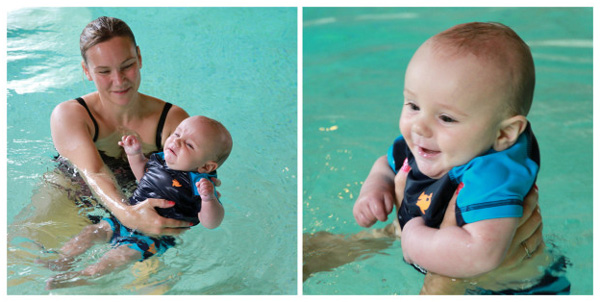
by jowilson1 on December 1, 2015
Babies cry because they need something, and crying is their only way to express their need verbally. When they cry, it means that something is wrong that makes them uncomfortable.
In the pool, some parents feel bad if their baby starts crying. But in reality, that's the whole point of participating in a gentle swimming program with our child. We learn to respond to them, to listen to them, to understand their cries and their body language. If a baby shows signs of distress, a good swimming instructor will stop the exercises, reassure them, and show the parent a different way to hold them or swim with them.
Manolis says...
"grrr I'm not happy, mom"
"Ah, now I'm better, I can smile again!"
Aside from the pool, some parents believe that if they react every time their baby cries, then they won't learn how to calm down on their own. In fact, some believe that their child cries because they are trying to manipulate them. However, this is not true, since babies simply need their parents' hugs and care and want to know that they are there for them.

When we react immediately to a baby's cry, it feels safe and loved, and we bond more with it.
Does crying always sound the same? Dunstan Baby Language pioneer Priscilla Dunstan believes not! Her work is based on 8 years of research into the cries and sounds of over 1000 babies. Of course every baby is different, but Priscilla believes that all babies' sounds follow a universal formula.
When a parent is able to hear these “baby words,” they will be able to understand their child’s sounds and signals and feel in control. Of course, this is not true for everyone, as some children’s cries are easier to interpret than others!
Could this be a tool for swimming teachers as well?
Dunstan Baby Language

"No" = Hunger
Try to hear the 'n' when the tongue touches the roof of the mouth. It's amazing how some moms feel their breasts producing milk when their baby makes this sound.
"Ow" = Sleepy
This sound resembles a cat's voice and comes from the yawn reflex.
"Heh" = Discomfort
Try to listen for the 'x'. Your baby may be getting hot or cold, his diaper may need changing, or his clothes may be too tight.
"Ear" = Abdominal pain / gas
Try to hear the 'r' reflexively caused by pressure on the lower intestine.
"Eh" = Burping
The sternum reflex pushes air out.
ATTENTION: The research of so-called “baby experts” should not belittle the natural instincts of parents. Every baby is different, and so is their crying. We should always encourage parents to be more confident in order to get to know their child better. When we see a parent struggling and not being able to meet their child’s needs, perhaps we should mention it.
Let's move on to the pool now...
Swimming lessons should always be a fun experience, for both parents and babies. Forcing a baby or toddler to do something against their will is definitely a big mistake. These awful “self-rescue” videos are proof. The repetitive crying and screaming of young children often goes unnoticed.
Does your swim school follow policies that discourage crying?
When a baby starts to get fussy, give up, and pull away from the parent, they are definitely trying to say something. Encourage parents to check in on all of their children's obvious needs (tiredness, hunger, sleepiness, or cold).
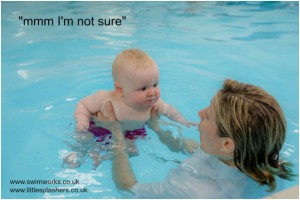
It's better to stop swimming than to let your baby cry loudly. Look at him, ask him how he's feeling, and try to calm him down by holding him and rocking him gently. If the crying turns into screaming, then it's time to stop the lesson for the day.
Babies know how to express their emotions. They express their distress by crying. Prolonged distress can have a negative effect not only on swimming lessons but, as has been scientifically proven, on the baby's brain, which secretes the toxic stress hormone "cortisol». Stress should be avoided whenever possible, as it can lead to a tendency towards chronic anxiety in the future (Gerhardt 2004). The good news is that babies do not need perfection. Interaction with parents should simply be “good”. Children quickly become aware of reality and see that life is not always perfect (Winnicott, 1992).
A guide for parents – useful tips for less stress and crying
1. Arrive at class early enough to have enough time to relax and get ready.
2. Schedule the lesson according to the baby's meal and sleep times.
3. Choose a swimming school that helps you relax during the lesson.
4. The gentle holding and movements in the pool will help both you and your baby relax.
5. Forget what the other kids are doing in class and focus your attention on your beautiful baby. Smile and talk to him.
6. Try diving only with a qualified swimming instructor.
7. Listen to your baby's sounds and understand them before they turn into crying.
8. If any activity during bath time upsets your baby, try not to stress. Just take a break and reassure your baby.
9. If the swimming school encourages you to continue or ignore your baby's crying... it's probably time to look for another baby swimming school.
Enjoy the joy that baby swimming offers!
Translation: Katerina Liakopoulou
Sources:
Dunstan Baby Language
Priscilla Dunstan Interview on Oprah
IAIM, Listen to Baby before they Shout
Center on the Developing Child. Toxic Stress in the Developing Brain, Harvard University
No Crying Policy – World Wide Swim School
Gerhardt, S. 2004 Why Love Matters: How affection shapes a baby's brain.Routledge
Winnicott, D. 1992 Pediatrics to Psychoanalysis. Karnak
The other day before I gave my little one a bath, I realized that her body smelled the same as the last meal I gave her. Strawberry smell! UNBELIEVABLE!
She was so happy about the bath that was coming. I made sure the room temperature was stable, put on some soft music, and the games began. Suddenly, I accidentally splashed her face. I could tell from her expression that she didn't like it at all.
Therefore, it is very important to understand that our child is the one who guides us in what pleases them and what does not.
Bathing is such an enjoyable and relaxing process for babies, due to the fact that they spend a large amount of time during the months of pregnancy in the liquid element. We must take many things into account, such as the fact that every child is different.
The ideal water for bathing your baby is lukewarm water, around 36.5C, which is our body temperature. At first, we can use a special bath thermometer or the inside of our arm. As the child grows and his skin begins to tighten, the water can be less hot than before. Don't be afraid of bathing! If the conditions are right, believe me, your child will enjoy it as much as you do!
If you want to learn to swim, in addition to bathing with your child, see information about it here. baby swimming.
How to stop using a pacifier? 7 Ways to do it.
You should know that there is not just one specific method that you can follow to immediately get your little one to part with their beloved pacifier. There are different ways that many parents have experimented with and eventually succeeded, depending on what suited each person's psyche.
You just have to remember that this process shouldn't be traumatic for the child. And if at times you think you can't possibly stop him from sucking, take comfort in the thought that no adult walks around with a pacifier in their mouth.
Cut it out gradually. Start reducing the use of the pacifier during the day. Usually the child craves the pacifier because he has nothing else to do. Keep him busy with toys, books, other activities and limit the pacifier to bedtime until you eliminate it completely.
If your toddler is in daycare, explain to him that none of his friends have a pacifier. Encourage him with words like, "You're a big boy now" or "You're a big girl and you don't need a pacifier anymore."
More traditional ways to stop your little one from wanting a pacifier are to cut off the tip of the nipple so that it doesn't particularly enjoy using it.
Put something with a bitter or sour taste in the pacifier.
You can announce to him that the pacifier is lost forever. (The kitty took it to give to other children who don't have pacifiers)
Agree with your toddler that you will "leave the pacifier to the fairy."
Finally, you can simply throw it away.
Read more useful information here tips for new moms!
How wonderful it is to spend Christmas with your family! You all decorate the Christmas tree together with lots of ornaments and lights. The children write letters to Santa Claus, while Dad struggles to light the fireplace. Mom makes warm cookies and the whole house smells delicious! Then you all take a walk together in the city where it is decorated with lots of lights and beautiful, towering Christmas trees. This way, the children have really gotten into the Christmas spirit!
“Christmas for children is the best day of the year and the most magical time of the year. They look forward to it with impatience, because they don’t have school, because they wait for the gifts that Santa Claus will bring them, because of the special decorations we make at home and especially in the city. For all these reasons, Christmas for children is the best time of the year,” psychologist Chrysoula Mavraki tells us.
Armed with...Beautiful Memories!!!

Parents and… consumption
“Parents approach Christmas precisely with the awareness that it is an amazing day for children and they try to create a program for them that includes activities. They buy them lots of gifts and do everything they can for their children. The bad thing is that they do everything they can for their children within a consumerist mindset. In other words, they believe that with lots of gifts, lots of games, lots of outings… they have made their children experience a wonderful Christmas,” the psychologist points out.
"The message of Christmas is love, philanthropy (loving others), companionship and giving. We should see Christmas as a time when we will stay at home more, be more relaxed, be able to play meaningfully and communicate with children, listen to them and talk to them."
"But first, let's listen to them, because all the rest of the time we don't hear them in the rush from here... to there, from school to daycare, from daycare to another daycare. It's not easy to listen to our children, nor to discuss with them. We need to show them that the spirit of Christmas is the spirit of giving and not just the spirit of consuming and demanding gifts."
Some tips!
-Make gifts with your children. Cards, handmade crafts, sweets... Wrap them beautifully and give them to loved ones.
-Don't spend money thoughtlessly on gifts that anyone can find in any store.
"Thus, we accustom the child to a spirit that does not have consumption in it, but passion, a personal stamp, caring. He learns that a gift is love and thought. Not that a gift is an obligation and if you don't give me a gift or a great gift, you are not a good dad, godfather, Santa Claus," emphasizes the psychologist.
-Visit grandparents, godparents, and all the people you see little of in everyday life.
-Take beautiful walks so that they can fill their eyes and ears with beautiful sights and beautiful sounds.
-Get plenty of rest, take a nap... because this is the spirit of the days and not the spirit of fatigue, staying up late, eating too much, and spending too much.
Finally... CAN'T WE BECOME CHILDREN AGAIN THIS CHRISTMAS WITH OUR CHILDREN?
by Angeliki Christopoulou
With the collaboration of psychologist Chrysoula Mavraki

 English
  Greek
Greek