


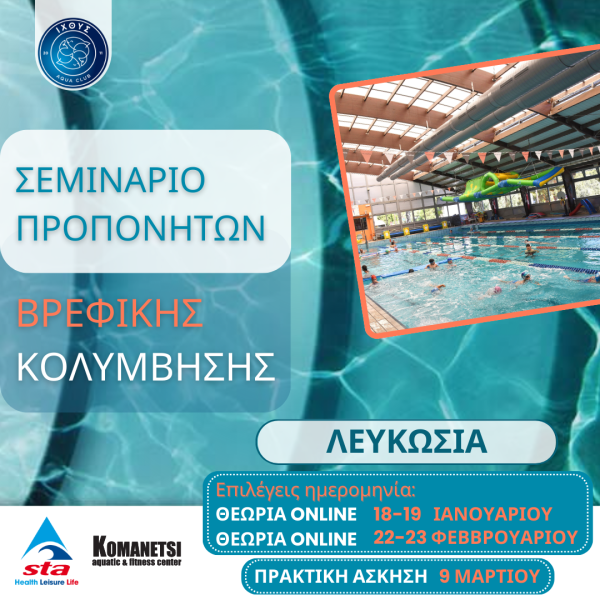

STA Infant and Toddler Swimming Coach Certification Seminars, 2024-2025
Following our many years of coaching and educational experience, in the field of organizing a successful series of seminars for coaches in infant and preschool swimming in Thessaloniki, under the auspices of course, of the British swimming academy, "Swimming Teachers' Association (STA)", we continue unabated and are pleased to announce the next Infant and Toddler Swimming coach seminars.
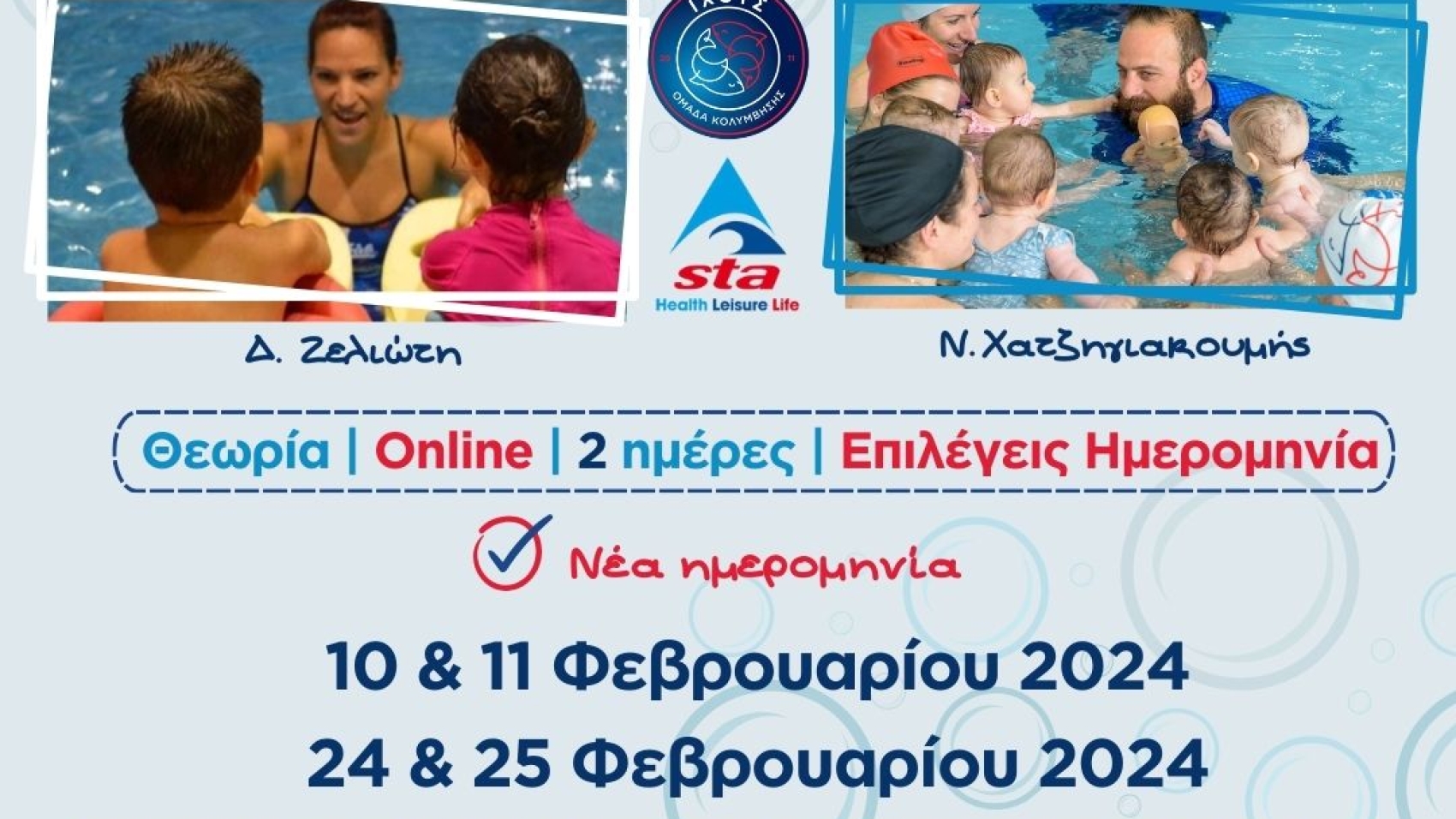
STA Infant and Toddler Swimming Coach Certification Seminars, 2023-2024
Following our many years of coaching and educational experience, in the field of organizing a successful series of seminars for coaches in infant and preschool swimming in Thessaloniki, under the auspices of course, of the British swimming academy, "Swimming Teachers' Association (STA)", we continue unabated and are pleased to announce the next Infant and Toddler Swimming coach seminars.
STA Infant and Toddler Swimming Coach Certification Seminars, 2023-2024
Following our many years of coaching and educational experience, in the field of organizing a successful series of seminars for coaches in infant and preschool swimming in Thessaloniki, under the auspices of course, of the British swimming academy, "Swimming Teachers' Association (STA)", we continue unabated and are pleased to announce the next Infant and Toddler Swimming coach seminars.
STA Infant & Preschool Swimming Coach Certification Seminar, April 28-30, 2023
Following our many years of coaching and educational experience, in the field of organizing a successful series of seminars for coaches in infant and preschool swimming in Thessaloniki, under the auspices of course, of the British swimming academy, "Swimming Teachers' Association (STA)", we continue unabated and are pleased to announce the next infant swimming coach seminar!
STA Infant & Preschool Swimming Coach Certification Seminar, November 04-06, 2022
Following our many years of coaching and educational experience, in the field of organizing a successful series of seminars for coaches in infant and preschool swimming in Thessaloniki, under the auspices of course, of the British swimming academy, "Swimming Teachers' Association (STA)", we continue unabated and are pleased to announce the next infant swimming coach seminar!
Backflips in swimming? What's wrong?
Backflips in swimming?
Is my child doing backflips in swimming? We have been swimming for so long, we enjoy all the benefits and suddenly he refuses to do dips or backstroke... What's wrong?
Should I listen to what he really wants to tell me with his body movements or his words?
The “setbacks” or, more correctly stated, the “transitional phases” of the child are not at all worrisome. On the contrary, they are normal reactions to the stages of his development. More specifically, there are three age-related transitional phases, where the child can maintain a plateau (a stagnation) while until now we have observed a continuous rise in his swimming development. So the stages and the reasons why our child reacts particularly, are the following:
10 months – 2 years
 At this point the child maintains an upward trajectory and each time learns and gets acquainted with more things. This is where we need to give him all our attention as everything he is learning, he is seeing for the first time. Even though we consider it routine, for the child it is something new. His upward trajectory should excite us quite a bit, but we should also observe when he can continue and when he needs a more relaxed lesson.
It is important to be careful that when our child reaches a point and is now familiar with diving (he does not drink water, the distance of the dive increases and their number) that parents do not exceed the limits and listen to the coaches and their children, as we will lead them to the opposite results, namely to denial towards diving. He will have all year round to fish for octopuses once he starts swimming on his own!
Furthermore, after 10 months when the child begins to stand up, step on his feet and enter the first process of walking, he may make a backward turn from the supine position. This is very possible and logical because children at this stage begin to discover the world and do not prefer the supine position. Also, they have a very increased sense of fear, that is, that they will fall backwards and this is another reason.
2.5 years old – 3.5 years old
 Our child has now become familiar with the water and diving and we are now calmer and more confident in what he can achieve. At this point, the separation of the child from the parent in the pool begins. And where everything is going well and nice, we begin the childish... Let's think of it as a double separation. In the child's mind, everything seems more difficult.
At first, we slowly manage to say goodbye to school, with a hundred kisses, hugs, tears and daily friction!!… But we manage. After a while, and while the child has become accustomed to going into the pool with his parent since he was a baby (and it is his favorite activity with mom or dad), he suddenly has to say goodbye to them from the pool. If we are close to the beginning of the school year, the child makes the association with leaving school and everything is more difficult for him. The opportunities he is given to adapt are once a week and not on a daily basis like in kindergarten. So, perhaps for some more emotional children, the separation from mom or dad may take a little longer.
As parents, we need to give our child the time they need to understand that they are ready to trust themselves, their coach, and their teammates and to swim on their own. At the same time, we need to be relaxed and accept the fact that some children are ready to be separated from their parents more quickly, while others need extra time.
5 years old – 6 years old
 We're all grown up now and we dive for octopuses, we do somersaults, we jump from high into the water, we're fearless! But, now that we're independent from mom and dad when it comes to our swimming skills, we have more choices in the activities we can do...
Many times the modern lifestyle and fast pace make us burden the child with everything he needs to learn, (mainly our own wants). Many times forgetting that he is a child and that he wants to play. So, at this stage we may observe some elements of denial because our child would like to try another sport, perhaps because his best friend plays football or he saw the basketball cup final on TV and dreamed of himself shooting in a full stadium!
Furthermore, there is a possibility that he feels that his schedule is too busy (e.g., immediately after ballet or soccer he has swimming practice or immediately after swimming he does French or tae kwon do) and while he wants to continue because he likes swimming and is trying for it, he cannot perform and follow his team.
The key to this fantastic relationship between parent and child is understanding and patience to listen to everything the child wants to tell you, whether through their body movements or their words. We need to put a limit on their activities before they reach their limits. In fact, it has recently been proven how beneficial it is – for the child’s brain activity (!) or boredom. With the child bombarded with activities, they don’t have time to find what they really like! But when they get bored, they are forced to find ways to keep themselves busy and therefore listen to themselves!
It's normal to worry about your child's future development, but every child needs their own space and time to show you how much they can achieve... and if you give them these two important elements, they'll surprise you...
Avgi Hourlia
Read below other articles about baby swimming
Why don't we do trials and why is our subscription three months long?
 Many parents are thinking to themselves, and perhaps some of you – fortunately – dared to ask us:
But hey, can't I just take a trial lesson to see how it goes? What if my child doesn't like it? What if I don't like it? And I'll pay for a whole trimester?
Reasonable questions for sure!
But here are 5 reasons why we won't do you any favors...!
1. Safety and intimacy
 The main reason we don't have trial lessons is that our program is based on love. And love for anything, not just water, cannot be judged on one occasion... Safety and familiarity are one of the basic feelings that a child and a parent must feel. Coming to a trial, which means entering a place you don't know for the first time with your child, where everything is new, the water, the coach, your classmates, doesn't have time to develop feelings of familiarity and safety. A person needs time to trust someone else. So how will your child be able to get used to all this new information that is spread out in front of him for the first time? Just think for a moment about how a child feels when he sees a pool for the first time: A large mass of moving water - what is that? Are you going to suck me in? With a guy in a suit - Who is that, my God? – and endless colors and songs and and and… That's why, for the child to become familiar with the space, the coach and the other children, he needs at least 6 lessons.
2. Self-belief
 Our program is educational. The child does not come just to pass the time but also to learn. And to learn, it takes time. If at the first dissatisfaction the child gives up, he will give up forever. He will be left with a negative image and will associate it with something he did not succeed in and will repel him for a long time, perhaps forever. But if you find a way to unlock it, through opportunities, time and many choices and games, then feeling safe in the water is guaranteed forever. This is where the proper training of coaches comes in, who will help the child see the water with a happy eye and believe in himself. When he believes, knowledge is automatic and never leaves.
3. Commitment and responsibility for proper hygiene
 In order for someone to participate in our program and maintain the hygiene of the pool - one of our main concerns, as the pool is used by infants and pregnant women - it means that they must have gathered all the necessary medical certificates: a medical certificate from a pediatrician for the child, a medical certificate from a pathologist, dermatologist, gynecologist for a female companion and a medical certificate from a pathologist, dermatologist for a male companion. So how can we ask someone to provide all these certificates for just one lesson? It requires commitment from all participants and responsibility to maintain the hygiene and smoothness of the program.
4. Careful treatment and coping with fears
 The 95% of children love water and from the first lesson they “break it”. However, there is a possibility that a child has a trauma with water. For example, after a drowning or burning incident and has developed a phobia. In a coastal country like ours, it is unacceptable to have children who drown in a few centimeters of water or are excessively afraid of water. In the best case scenario, the parent has understood where the problem started and so from the beginning we enter into a very calm and long-term program of familiarization with water, with the aim of the child completely overcoming the problem. In these cases, the ideal period for the child’s “recovery” is the 6 lessons, through a fully studied education program again through love. In the worst case, the parent has not understood where the dissatisfaction started (of course, here we are not dealing with a phobia, but with simple dissatisfaction, which however inhibits the child from testing his abilities in the water). In this case, the parent has not understood that the child was dissatisfied somewhere (e.g. in a shower at home, water suddenly fell into the child's eyes and from then on the child screams as soon as you go to wet him) and a trial lesson can be disastrous for his subsequent experience in the water. With a trial lesson, we will not even have time to understand whether the child needs more careful treatment due to the bad experience, in order to finally overcome the dissatisfaction.
5. Smooth operation and team bonding
 Then there is the organizational part. Imagine starting a swimming class with your child and having 2-3 other children in each lesson – individually each time they “try out”. Baby swimming is a team game and if we have trial lessons, no one will ever become a team. One of our/your greatest rewards is that families bond with each other, you become best friends, you go on vacations together and with a trial lesson, you don’t even give your own interpersonal relationships a chance to develop, with people who are very likely to be a good match, since you chose the same activity for your child.
Why is our subscription three months long?
Ideal adaptation time
The ideal adaptation period that we believe a child needs in Pisces is three months. Hence the quarterly subscription, which you can pay in 2 installments, so 1.5 months of trial billing. During this period, the child and the parent are able to understand if swimming is something they want to continue. And don't forget that the lessons are only once a week, so three months is a good amount of time to try something out to see if it fills you up. Just like in kindergarten, it takes time for the child to adapt. In an equally important learning program, why should you decide on just one lesson?
What should I look for in a swimming pool?
What specifications should a good baby swimming pool have?
Swimming is now something that has begun to pique the interest of many parents because it is the most safe way to exercise, without stress. It is a wonderful activity that you can do with your child and one of the few activities that you can follow from 40 days to 140 years old!!!
We all want our children to learn to swim, both to strengthen their bodies and for greater safety in the sea, but what should we pay attention to? What should you look for in the coach or staff who will support your child and you?
Here are the 5 basic things a parent should look for in a swimming learning center.
Physical and psychological safety
Water, no matter how familiar someone is, requires caution, so your number one concept should be training of coachesThey have recent knowledge. lifeguard and first aid? No matter how much knowledge you have, instructors are always next to the child, so they are primarily responsible for the safety of children in the water.
Second, but no less important, is the training of coaches and people in secretariat, with regard to pedagogical methods. Above all, it requires love for children and contagiousness. Just because I was once a student, it doesn't mean I can teach, nor, of course, because I was an athlete, I can coach properly. Therefore, training in a gymnastics academy or in pedagogical departments and of course in a series of seminars about new methods of approaching and learning infants and toddlers. Counting tiles while swimming is boring for us adults, let alone for children… With orders, few people loved anything… Through play and laughter, however, knowledge is acquired forever!
Hygiene of the space
When you go to see a pool area you should check the facilities. That is, how comfortable are the places where you will change your child, which ones storage spaces there are, how many net is the space that will host you for your lesson, if there is a waiting area for breastfeeding or if there is a waiting area for the sibling or to drink a coffee like a human being, brother!!! Are there hairdryers and in what conditions are they maintained? Also, we should see if the floors are clean and, above all, anti-slip, because your child will definitely start running like crazy from joy and no matter what slippers you have, if the floor is slippery, the pirouette is guaranteed! Where there are steps, there should be handles on both sides of the wall so you can grab on in case you slip or if you simply want support because you are holding your child in your arms.
It is also very important. the air that we breathe in the pool area. Is it stuffy, cold and humid, or hot and steamy? A proper pool area will be warm but not excessively humid (observe the windows, if they produce water vapor) and of course without a strong smell of chlorine. If the ventilation is not satisfactory, there is a possibility that germs will be transmitted to this area as well, so pay attention to the ventilation of the area!
Water purification
The ages for which baby swimming and learning are aimed are young, which is why it is recommended to avoid a pool that is only disinfected with chlorine. Nowadays, there are so many other ways of cleaning, such as ozone, the bromine, UV, salt etc., where they are not so caustic to the skin, nor do they burden the eyes and respiratory system. Of course, a percentage of chlorine, equivalent to drinking water, is necessary for 100 % of disinfection or some combined methods for better coverage. Also, the pool water should be recirculated frequently, frequent sampling should be carried out, the results of which should be in public view and of course, those who use the pool should bring the necessary medical certificates, but also take a mandatory shower before entering the pool!
Water temperature
Depending on the age group we are targeting, the ideal pool temperature is adjusted accordingly.
For infants up to 40 days old, the ideal temperature is 36-37 degrees Celsius.
From 40 days to 5 years, the appropriate temperature is approximately 32-33 degrees, always taking into account that every child is different and that if a child seems to be getting cold at this temperature, they can reduce their stay in the water.
After the age of 5 up to the age of 105, we ideally swim at around 27 degrees, where it is neither cold enough to freeze, nor hot enough to be sluggish...
Humans need about a quarter of an hour to adjust our body temperature to new conditions, so the right temperature is a very important part of enjoying playing in the water and not making it seem like a chore!
Of course, if you have something to add that we didn't think of, such as having people dry, feed, and dress your children, please add it below 🙂!
Hadjigiakoumis Nikolas
Program Manager
Baby swimming fish
Kalamaria Miaouli 18.
Saint Luke's Clinic –
Egnatia Palace Hotel –
6955 066 413 – 6989 66 57 57
info@babyswimthessaloniki.gr
 English
  Greek
Greek